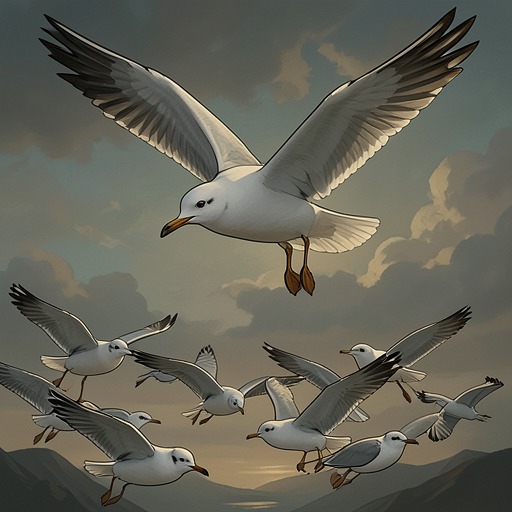
Great Gull
Jonathan Livingston SeagullThe Great Gull is both an image of an unlimited freedom and a principle that the gulls learn to recognize in themselves. It gives flight a meaning beyond travel or technique: practice can become a way to express an underlying nature, while liberation depends on seeing beyond the limits that seem to define the body. The idea passes from Jonathan Livingston Seagull’s teachers to his students, and finally into Fletcher Lynd Seagull’s own teaching, where it becomes a practice rather than a doctrine about a divine exception.
Identity and Meaning
For Jonathan, the Great Gull stands behind a possibility already present in every gull. He tells his students that each is an idea of the Great Gull and an unlimited idea of freedom; precision flying is a step toward expressing that real nature. The claim does not make technique irrelevant. Instead, repeated practice in high speed, low speed, and aerobatics serves as a means of putting aside whatever limits the gulls have accepted.
The Great Gull is also connected to the way Jonathan understands his own identity. As he prepares to leave the world in which he has learned, he holds an image of the great gull-flocks on a shore in another time and recognizes himself not as bone and feather, but as a perfect idea of freedom and flight, limited by nothing. The transition from bodily bird to idea does not cancel his love of flying; it gives that love a larger frame, in which flight embodies rather than exhausts freedom.
Flight, Perfection, and Learning
Jonathan’s devotion to flight begins in contrast with the ordinary priorities of the flock. Most gulls learn only enough to travel between shore and food, because eating matters more to them than flying. For Jonathan, flight itself matters most. His experiments and devotion therefore anticipate the later teaching that flying is not merely a useful movement: it can reveal what a gull is capable of being.
That understanding develops through learning rather than arriving as a simple declaration. In the world where Jonathan continues his training, Chiang explains that heaven is not a place or a time, but being perfect. Perfect speed is not a measurable velocity: any number imposes a limit, whereas perfect speed is being there. This teaching makes the Great Gull’s freedom more than a promise of faster movement. It points toward a condition in which the usual measures and boundaries no longer govern experience.
Chiang also links Jonathan’s further progress to learning kindness and love. He proposes that Jonathan work with time, learning to fly the past and future, before beginning the most difficult and powerful flight: understanding kindness and love. When Chiang later vanishes, his final instruction to Jonathan is to keep working on love. The sequence places love not outside the pursuit of flight, but among its highest lessons.
A Principle Against Limitation
When Jonathan teaches his students, he gives the Great Gull’s principle a direct practical consequence. He tells Kirk Maynard Gull that he has the freedom to be his true self here and now, and names this the Law of the Great Gull. Kirk has said he cannot move his wing; Jonathan answers not with a mechanical explanation but with the assertion that he is free. The exchange presents self-understanding as something that can change what appears possible in the present.
The teaching also challenges the flock’s authority to define what gulls may do. When a voice asks whether even the Law of the Flock must be set aside, Jonathan replies that the only true law is the one that leads to freedom. He rejects the assumption that his students’ abilities are the product of a special gift reserved for a few. Pointing to Fletcher Lynd Seagull, Lowell, Charles-Roland, and Judy Lee, he argues that they are no more divinely exceptional than the other gulls; they have begun to understand what they are and practice it. The Great Gull’s law is thus not a privilege conferred on a chosen bird, but an invitation to recognize and develop a shared capacity.
Teaching and Transmission
The idea’s force depends on how it is transmitted. Jonathan’s students enjoy the speed and excitement of their exercises, and each lesson feeds their hunger to learn. Yet they struggle to believe that the flight of ideas can be as real as the flight of wind and feather. Jonathan tries to express the connection by telling them that the body, from wingtip to wingtip, is thought in visible form, and that breaking the chains of thought also breaks the chains of the body. To his students this sounds like pleasant fiction, so the principle remains more difficult to grasp than the maneuvers they practice.
That gap between repetition and understanding is exposed when the flock questions whether ordinary gulls can fly as Jonathan does. His answer makes the teaching communal: Fletcher and the other students are not special or divine, but have begun the work of understanding and practice. Even his students shift uneasily when they realize that this is what they themselves have been doing. The Great Gull’s freedom cannot be reduced to a rule for a loop; physical skill offers an entry into a larger discovery, not a substitute for it.
Fletcher’s Inheritance
Jonathan’s departure tests whether the teaching can survive without its original teacher. As his body shimmers and becomes transparent, he warns Fletcher not to let the gulls turn him into a god through rumors. He is a gull who likes to fly, not a divine exception. He tells Fletcher that he no longer needs Jonathan: the real, unlimited Fletcher is himself the instructor he must find and practice. The Great Gull’s ideal therefore requires self-discovery, not permanent dependence on a master.
Fletcher takes that responsibility to a new group of students. He begins with Jonathan’s teaching that a gull is an unlimited idea of freedom and an image of the Great Gull, and that the body is thought made visible. The young gulls look puzzled; they want a rule for a loop. Fletcher starts again with level flight, but in doing so understands that Jonathan was no more divine than he is. For a moment he sees his students as they really are and loves what he sees. His recognition turns the inherited principle into a living practice: instruction begins with an accessible maneuver, while the deeper understanding grows through teaching, seeing, and learning in company.